skip to main |
skip to sidebar


 bigger yonder
some weeks the csa box is more impressive than others. this is one of those weeks. (even pinky leon is impressed—basil sniffing kitty). all of the sudden the colors changed. deep purple grapes and figs and green green peppers. i'm not even a pepper fan, and these look good to me. they look like they are especially crisp, don't they? i had been refraining from buying the hyper expensive figs at rainbow grocery, but they were wearing me down looking so plump and soft and ready to burst. pretty sure i gasped when i opened the box this evening and saw all the figs. just what i wanted. YUM. feeling grateful and lucky. right now i am reading eaarth (that's with two as for a reason), by bill mckibben. the first half of the book is all about how we cause(d) climate change and about the tragic consequences that change is having across the planet. it's eye opening to read about the crazy many small and large ways climate change is affecting the earth and just how badly we are screwing ourselves. parasite and insect booms, forests dying, species dying, tropics expanding, tundra thawing/releasing bursts of methane, drought, storms. mckibben writes about how we are altering large and important (for earth's climate and for our survival) natural features of the earth (the ocean, the rain forest, the ice caps) so extremely and in mostly irreversible ways! people who like doomsday stories, this might be a book for you. luckily, there's a second half to the book. i'm just getting to that part, but so far it's intriguing and oddly optimistic, given the frightening first half. i'll report back when i'm done with the book. (did you know reagan removed the solar panels from the white house when he became pres? it's almost comical.)
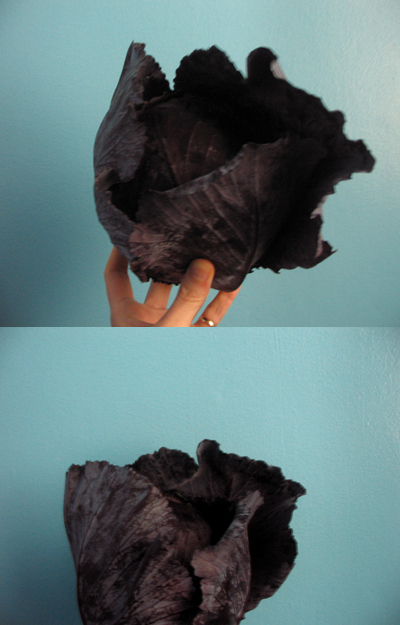
when i opened up the csa box last night and saw this cabbage (which looked better last night, pre-refrigeration), it reminded me of abby's beautiful photo of the amazing kmk cabbage.
i am not going to tell you where in the flat my cabbage photo was taken though. let's just say the turquoise walls (which are way more blue and bright in person) of a certain room seemed like they'd make a pretty background for the purple. (i hope my housemate and csa box sharer is not reading this.)
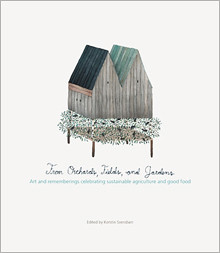
today i wrote a letter to one of my favorite authors to request permission to include some words of his in this book i'm compiling. the piece with his words in it is not by me, but the permission request "allowed" me to express my gratitude to him. (of course he is probably not the one reading the letter, but i wrote as though he would be reading it, and that felt quite nice.)
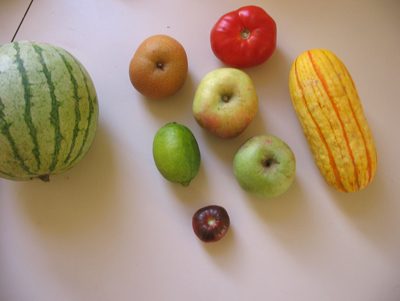 a stanza from may swenson's green red brown and white:Bit an apple on its red
side Smelled like snow
Between white halves broken open
brown winks slept in sockets greencute lamb story


i feel rich when i look at the contents of our weekly produce box. compared to a lot of people in the world i am rich, but compared to people in SF, i don't have a lot of money. aside from rent, i spend my money mostly on food. but to me, that feels right. food is important and delicious! look at all those red jewels—cherries (so sweet), strawberries (so ripe i was forced to make yet another crisp) and peaches! i have always been more interested in veggies than in fruit, but when it comes straight from the tree and is twinkling its shiny sides at me, i do fall for fruit. in fact it's hard to resist eating it all at once! (i just got the culture club i tumble for ya song stuck in my head.)
ps. even though i am rich in food, our csa box is so reasonably priced. i get all the organic fruits and veggies i need for about $13.00 a week.
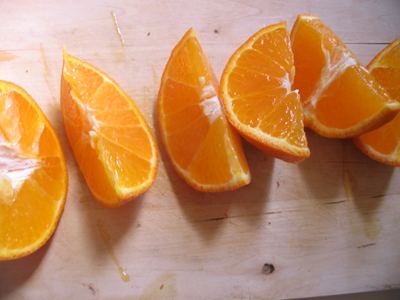 at home sick today. eating oranges and listening to the royal tenenbaums soundtrack (checked out from the library).also reviewing adam lambert's beautiful mad world. and the tears for fears version of mad world. (please see the sweet dancing starting at 2:27 seconds.)
since i recently finished a (primarily print) graphic design program, i've been looking for graphic design jobs. it's a pretty rough job market right now given that many talented and experienced designers are being laid off. and most of the jobs available are for higher level designers or web/flash designers. so i've been considering other jobs in the interim, but it's so hard to know what to look for. i used to do administrative work and editing. and while i wouldn't mind doing this part time, i would rather not do it full time.
i keep mulling over what i really like and what i like to do/think about:
books
sustainable agriculture
reading fiction, nonfiction, blogs (you might think this would fall under books, but for books, i actually mean the physicality of books and the design of books.)
writing/editing
hanging out with old people
sewing/making
taking walks
organizing gatherings (this one is a bit odd since i'm an introvert. but i'm an introvert who likes to be social {in spurts and as long as i can go home and turtle after}. i'm just realizing this lately, that i like to organize little events—well i suppose i like the planning more than the hostessing.)i wish there was a way to combine my interests in craft, design, writing and sustainable agriculture. i'd like to do design work for CSAs and for programs/blogs/organizations that support alternatives to industrial agriculture. (check out this great program i read about on civil eats. i want to design for them!)i (less seriously) think about doing a wwoof internship or applying to a sustainable agriculture-related master's degree program at uc davis.
i think about starting a green design studio with fellow classmates and artists who are in a similar position.
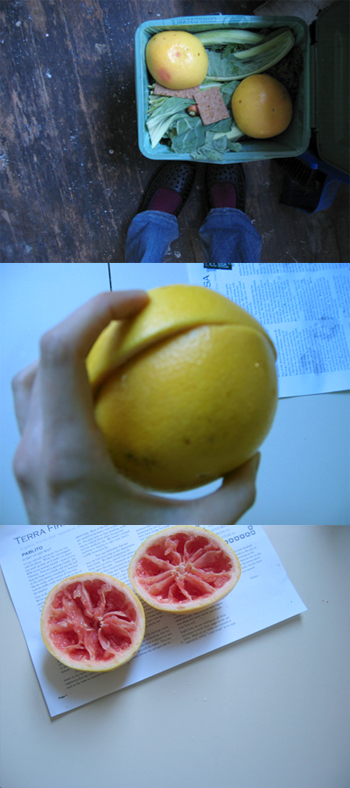
i think about dropping the class i'm taking, after our current project is done, and offering pro bono design services to my own csa, terra firma farms. it just seems like a better use of my time (both for the csa and for my own learning).
although it's terribly scary, it seems like now might be especially the time to dream bigger and not choose the safe route. though at the same time, i really need money asap, so i may have to go the safe route temporarily. all of this is alternately exciting and overwhelming/depressing/debilitating to think about. being unemployed is a roller coaster and it's really starting to wear me down!
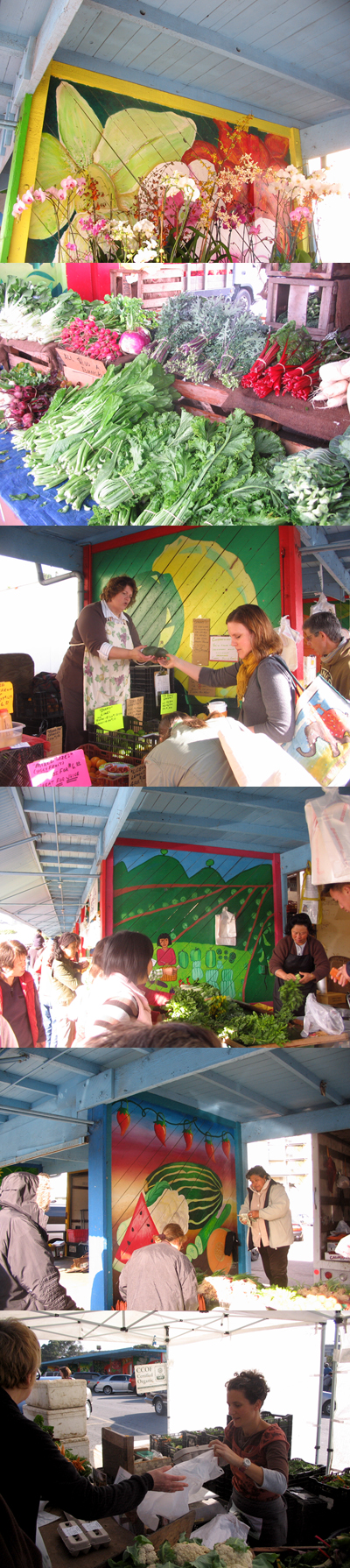 it's about time to start an alemany farmers' market set.
the precita eyes murals (and the diversity of farmers) make this market one of the most beautiful places in the bay area in my opinion.
i love how certain sellers seem to choose their stalls based on the mural.
i actually don't need to go to the market so much since i subscribe to a fantastic csa. but i go to spend time with friends and to experience the market and its saturated colors. i also like having something i do regularly on saturday mornings. (foods i do buy at the market include olive oil, honey, nuts, dried fruit and the occasional non-csa treat {asparagus today}).
 wanted to recommend fruitless fall by rowan jacobsen to you all. the book is about the honey bee and colony collapse disorder (CCD), which is a serious threat to the honey bee (and therefor to life as we know it). while the topic is frightening and depressing, jacobsen managed to completely engage me in his book. almost every page is filled with fascinating information about bees and pollination and how bees are essential to us for so many reasons. even the more scientific info is really accessible. i recommend reading this book in conjunction with the omnivore's dilemma, because CCD is almost certainly caused by the effects of industrial agriculture. for me it reiterates the urgent need to transform our broken agricultural system. in fruitless fall, jacobsen examines the myriad of factors that have been considered in trying to figure out why CCD is happening. in the end, CCD is mostly likely due to a combination of factors including:
*pesticide, herbicide and fungicide use (and the complete lack of studies on how various pesiticides, etc. react/combine with each other to become potentially exponentially more harmful) (pesticide use is probably the most influential factor. did you know pesticide safety is determined by test results reported BY THE PESTICIDE MAKERS!)
*the transport of hives (trucked cross country and flown between countries)
*bees forced to feed on monocrops (like almonds)
*habitat loss (lack of competition with wild bees, lack of varied nutrient sources)
*use of corn syrup to feed bees
*climate change
*development of wild and farm land (blocks flower scents)
*noise*possibly even the structure of traditional bee boxes. jacobsen goes into detail about how all of the above affects the honey bee, and i think you will be surprised by a lot of what you learn about these factors and how they interrelate. so good! now i want to read some books he recommends, including the forgotten pollinators.
let me know what you think/thought of the book!bee links
pollinator partnership
bee spotter
cross-posted at sew green
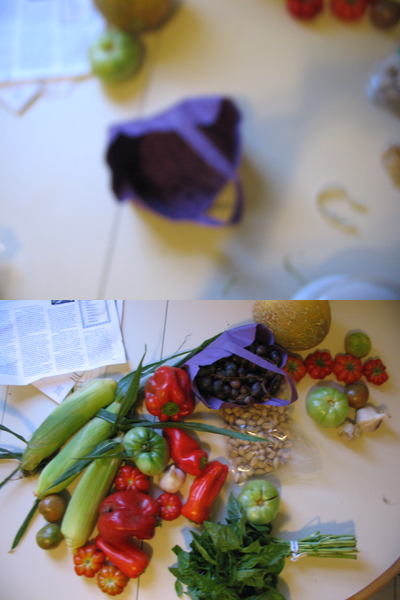
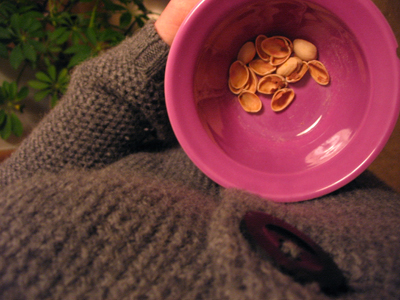 pistachios from this week's produce box from terra firma
"the whole horse: the preservation of the agrarian mind" is a poetic essay by wendell berry. in it, he beautifully explains the problem of industrial economy:
One of the primary results—and one of the primary needs—of industrialism is the separation of people and places and products from their histories. To the extent that we participate in the industrial economy, we do not know the histories of our families or of our habitats or of our meals. This is an economy, and in fact a culture, of the one-night stand...
...In this condition we have many commodities, but little satisfaction, little sense of the sufficiency of anything...the industrial economy's most-marketed commodity is satisfaction...this commodity, which is repeatedly promised, bought and paid for, is never delivered...
...The persistent want of satisfaction is directly and completely related to the dissociation of ourselves and all our goods from our and their histories...
...When there is no reliable accounting and therefor no competent knowledge of the economic and ecological effects of our lives, we cannot live lives that are economically and ecologically responsible.
he goes on to explain that the way to live economically and ecologically responsible lives is to build an agrarian economy, a local economy based on land. this is a subsistence economy and is a culture before it is an economy. (makes me think of this documentary i wrote about here.) he writes about how agrarianism is concerned with figuring out what is best (for the land, people, animals). "What is the best location for a particular building or fence? What is the best way to plow this field?..." All the questions are entirely site specific. local. and to answer them, one has to study the history of the place. knowledge must be passed down.
i tried to find a link to the whole essay online, but couldn't. it's very worth checking out from the library though. the essay can be found in the book fatal harvest and in the art of the commonplace: the agrarian essays of wendell berry. my summing up here, does not do the essay justice.
anyway, i think about all of this when i listen to economists and politicians talking about how americans need to start consuming again to get the economy back on track. just put more money into the system. makes me a bit sick to my stomach. seems to me that berry is right. we need an entirely different kind of economy. and now when our current economy is failing we should be looking at the deeper causes of the economic problems.
 (photo of the excellent book fatal harvest, from the chapter where they talk about CSAs)
i find myself getting more and more into food/farm books/issues. here are some good links i've come across lately:
civil eats "promotes critical thought about sustainable agriculture and food systems as part of building economically and socially just communities." (i also love their logo.)
local harvest is a great place to find sustainable farms and CSAs near you.
organic consumers association is a politically-focused site that posts great articles (from various sources). their millions against monsanto page is super informative and important. you can watch the documentary, the world according to monsanto here. i have only watched part of it, but that part was chilling and infuriating. and finally, some action! if you are interested in getting america to move toward a more sustainable agriculture, you can sign a petition to get some good folks in beneath the agriculture secretary: food democracy now's sustainable dozen.
(cross posted on sew green)(maybe this will be a food ranting week on my blog and the type/lettering will wait until next week...)
 Last night I watched this documentary on PBS about the Karuk tribe of California. They live along the Klamath River. The logging companies and the federal government’s fire suppression policies have almost destroyed the Karuk. The Karuk cannot gather their medicinal plants, make their traditional foods, practice their ceremonies, etc. like they used to, because the landscape, their home, has been altered so much. Fire suppression and the planting of fir trees has almost wiped out many of the native plants in the area. This also affects the river water (fir trees drain the water) and thus affects salmon and other river flora and fauna.
The Karuk believe that the earth provides everything we need. Watching this documentary, I recognized a lot of similarities between the Karuk’s values and those of the Slow Food movement. There is an understanding that ecology and culture are inextricable, and that the only way to maintain cultures is to respectfully and correctly manage the environment. This is also the only way the earth will continue to provide for us. This kind of value system is not an economic one, but a subsistence one.
Now when we’re in this big economic crisis, I think these values are vital for us to ponder. When we don’t trust that the earth and our community will provide for us all, we become greedy and we try to figure out ways to produce/extract as much stuff as possible at any cost. {As an example, industrial agriculture plants monocultures of crops, because in the short term that is the easiest way to produce a lot of food. This ruins the soil fertility however, which will not only make the land unproductive, but also endangers surrounding communities because the soil won’t absorb water. Thus when there is a flood, it is far more devastating. There are tons of examples how overuse like this not only leads to depletion of resources and the obliteration of biodiversity but also makes us much more susceptible to flood, fire, hurricane damage.}
In the book Plenty, the co-author imagines what the part of Canada he lives in looked like before Columbus. The abundance of animal and plantlife described struck me. Our earth has become and is fast becoming less and less abundant because of our incorrect management of the environment, our shortsighted overuse/exploitation of resources and our blindness (or willfull ignoring of) how we are connected to all creatures and plants. In the focus on profit, we (industrial societies) are killing cultures, we are killing plant and animal species, we are endangering lives by making communities more vulnerable to natural disasters, we are polluting water. The list goes on and on.
I worry that in hard economic times, people will look to the short-term solutions that (the agriculture, oil, etc.) industries offer, instead of re-evaluating our capitalist value system. But I hope having a visionary leader (in America) who seems to want us to fight for community and for what is right, might inspire us to work towards just and respectful ways of living on and sustaining this earth and the earth's abundance.
 i just finished reading plenty and was considering which i like most of these food books i've read of late: animal, vegetable, miracle, the omnivore's dilemma or plenty. i really can't decide. they are all terrific, well-written books. they all kept me rapt. they are funny, VERY informative, fascinating and mostly uplifting.
now i just want to keep reading books on these topics of the industrialization of food, global food issues, environmental issues related to food, local food/small farm issues, organics, the appreciation of flavor and food traditions, awesome chefs/cooks and the importance of diversity of crops/seeds.
it seems to me that the way we ("developed" nations) produce/consume/transport food (both in "developed" and "undeveloped" nations) is at the core of so many of the world's problems (hunger, obesity, disease, pollution, oil dependence, the end of thousands of small farms, spiritual disconnect). and as these books all touch on, food is one of the things we in america can control, on an individual basis anyway, to some degree. these books are uplifting because they are about people empowering themselves and their local farmers and food service folks. they tell of ways to avoid/battle/subvert/alter the gigantic, evil corporations and industries that control food production. plus there are mouthwatering recipes in these books.
i recommend them all! i am confident you will find them to be delectable.
have you read any related books i should add to my food book reading?
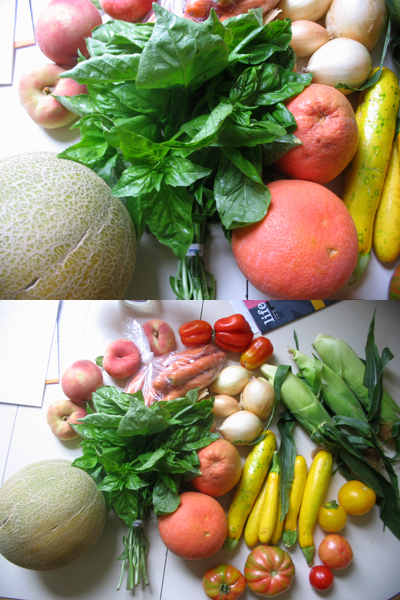
 more melon. this time cantelope. completely unrelated to the below.
my friend liz and i are headed up portland way in august for the pickathon music festival. (hopefully we'll be meeting up with miss sprout, her bob, their dixie dog and their extra sweet vw bus if they make it up {fingers crossed}).
my question for you is, do you know of any fun places to stay overnight approx. halfway (or a bit more than halfway) between SF and portland? maybe in ashland? any adventure stories (related or not) welcome!
thanks!
 i first read about the bee crisis a year ago in this great article in the new yorker. and then a couple days ago i read about it again in a much less in depth article on sfgate.
this pollinator partnership site is interesting. on the right you can click to find out what plants to plant in your region to help the bees (and us!). (the coastal calif. guide is not ready yet.)
the bee situation is frightening to say the least. i can't help but think it's related to all the crap we're putting into the environment and all the problems created by the industrial agribusiness corporations (evil monsanto, adm and cargill who are ruining our food and our land and our farmers, together with our government who is supporting these scoundrels).
in happier news: i had no idea about the robert plant–alison kraus collaboration. you can listen to the whole album on their site.
 a lot of people really don't like purple. i am not one of them, though i do usually prefer a bluer purple over the above.
i had never seen purple asparagus before these arrived in the produce box. last week we got fava beans, which i'd never prepared before. they require double shelling, but are very tasty. strawberries are also now filling our produce box, and they're so much more flavorful than the TJoes organic strawberries. CSAs rock.
in the most recent newsletter included in the produce box, Pablito talks about how the farm is made up of families (instead of being a family farm). organic farming is such a perfect example of how caring for the environment goes hand in hand with caring for people (those who grow/pick the crops and those who eat the food). same environment-people connection goes for any kind of manufacturing. it's so obvious (and i'm sure i'm ranting to the choir here), and yet $—over health, the environment and care—continues to be the priority for so many people and corporations. i wish there were laws that required all food to be grown organically, all paper to be processed chlorine free, and that banned all junk mail and automatic-flush toilets. (god i hate those things. they always flush unnecessarily like 5 times.)
i read The Diving Bell And The Butterfly today. it's really good. i was surprised at how true the movie was to the book, and yet what a beautiful interpretation of the words the movie was. both versions are poetic, poignant and so hopeful. anyway, i recommend the book and the movie wholeheartedly.
saw the charming beth orton the other night. i guess this was her first time playing out since having a baby over a year ago. she kept messing up songs and talking about messing up/being nervous. in between, she sang beautifully. i think her nervousness made the audience feel both nervous/uncomfortable and more connected to her. being a nervous person myself, it was interesting to watch her struggle through, and eventually really get into, and enjoy the song. that gal can sing.
hannah waldron (can't remember where i found the link. maybe through sandra.)
until friday most likely...